
We’ve all experienced it.
A dead zone in the bedroom.
A choppy video call from the basement.
Endless buffering during movie night.
Your Wi‑Fi signal looks strong everywhere, yet the experience falls short.
As broadband speeds push deeper into the multi‑gig era, expectations for flawless, wall‑to‑wall Wi‑Fi have risen just as fast. For consumers and for the broadband providers serving them, the default answer often seems obvious: deploy a mesh Wi‑Fi system and blanket the home with strong signals everywhere.
Mesh does solve coverage problems. It can efficiently light up Wi‑Fi dark zones and dramatically improve signal strength. But coverage alone does not equal performance. When mesh networks are overused or poorly architected, they can quietly undermine the very experience they were meant to improve.
In the race for “bars everywhere,” many homes and many service providers are unintentionally trading signal strength for something far more valuable: Wi‑Fi airtime. Retailers may try to sell Mesh Extenders as “Wi-Fi Boosters” but that promise results in unexpected product returns for failure to meet expectations.
More mesh, more power… and sometimes, more problems.
Coverage Is Easy. Capacity Is Hard.
My career has grown up alongside Wi‑Fi, from early desktop adapters to today’s homes packed with dozens of always‑connected devices. One lesson has become increasingly clear:
A strong signal is necessary for good connectivity, but it is not sufficient.
Wi‑Fi performance is governed by a shared medium. No matter how fast the broadband pipe is, every Wi‑Fi device in the home must take turns using the air. Airtime is finite. Once it is consumed, performance suffers.
Mesh systems excel at extending wi-fi signals into dark zones. Their “plug it in and it works” simplicity hs been a major win for a trouble-free self-install. That same simplicity has fueled a dangerous misconception: that mesh nodes are just harmless boosters you can add anywhere without consequence.
They are not.
The Invisible Workhorse: Mesh Backhaul
To understand the tradeoff, we need to talk about backhaul.
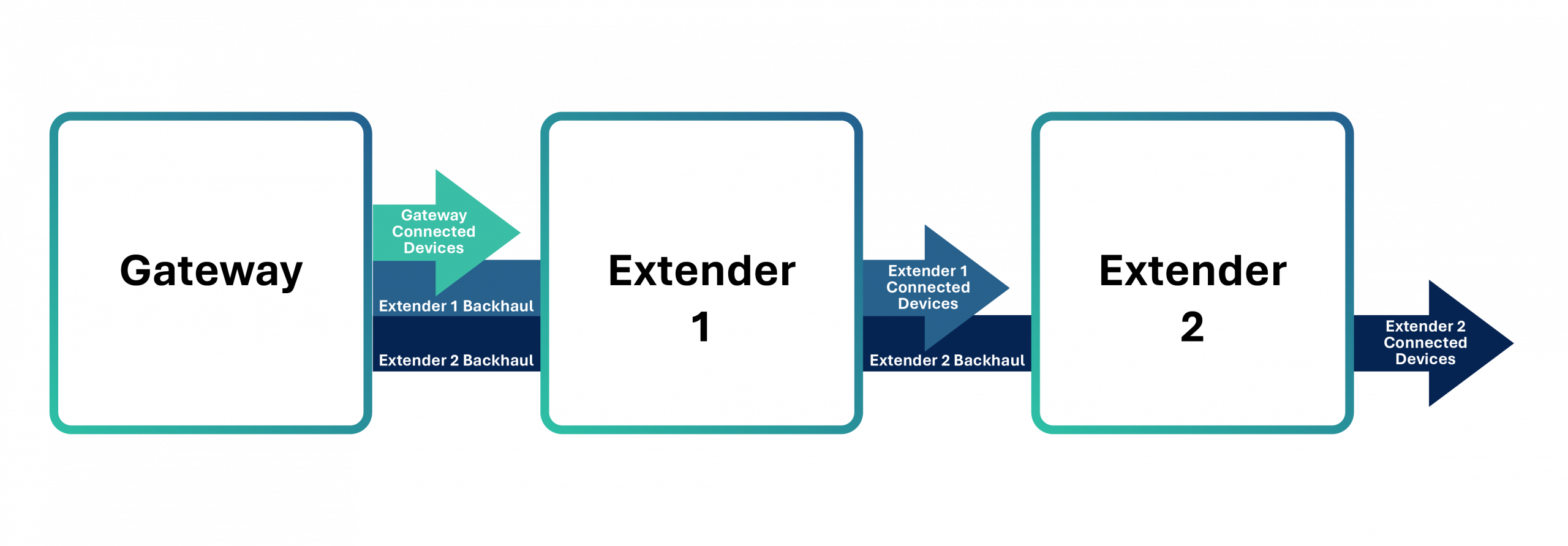
Think of Wi-Fi mesh backhaul like having to connect through ATL when flying between cities. If you’re starting in Atlanta, you can fly nonstop to most places in the world, just like a device that’s directly connected to your gateway.
But if you’re flying from one smaller city to another, you first have to get to Atlanta. That leg is the mesh backhaul for your data. There’s only so much capacity on those flights (seats), and when ATL gets busy, you might get delayed, miss your connection, or even get “bumped” from your final destination.
The more connections you add, the more congestion and delay you introduce, exactly what happens as mesh nodes relay traffic wirelessly instead of taking a direct path.
The result is counterintuitive but real:
- Devices show stronger signal strength
- Throughput drops
- Latency increases
- Contention rises
- Effective bandwidth per device can fall by 2× to 3× when traffic is relayed through wireless extenders
Coverage improves but capacity declines.

Airtime: The Most Precious Resource in the Home
Airtime is the true currency of Wi‑Fi. Unlike wired networks, it cannot be increased simply by upgrading broadband speed. Every wireless hop consumes time on the air.
This is why “Mo’ Mesh” can lead to “Mo’ Problems.”
Used surgically to light up genuine dead zones, mesh extenders are powerful tools. Used indiscriminately, they can starve the network’s available airtime in homes with high device counts and high bandwidth demand.
From a business perspective, this is a critical point. Customers don’t complain about airtime efficiency. They complain that their “gig service feels slow.”
Evaluating Common Mesh Architectures
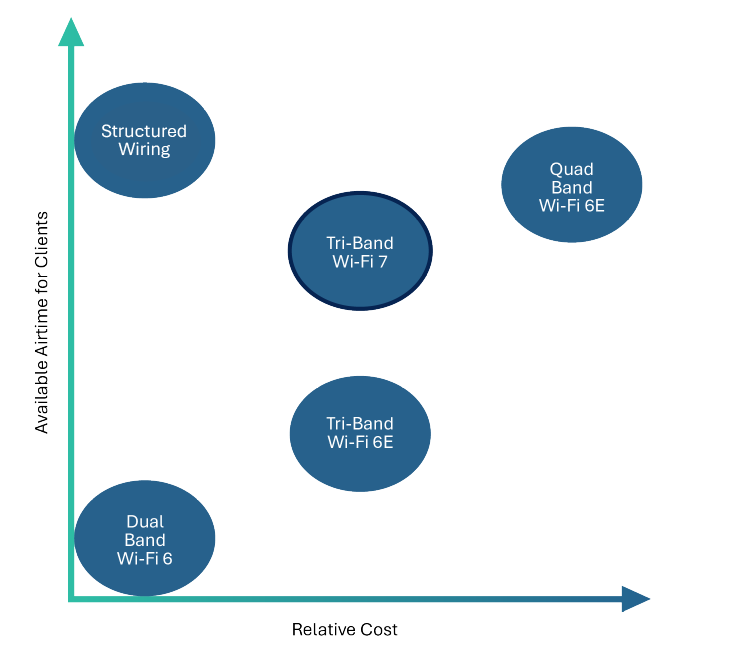
Several approaches dominate the market today, each with clear tradeoffs:
- Dual‑Band Wi‑Fi 6 (2.4 + 5 GHz)
Lowest cost, highest contention. Backhaul directly competes with client traffic. Suitable for small homes, but scales poorly. - Tri‑Band Wi‑Fi 6E (2.4 + 5 + 6 GHz)
Adds capacity and flexibility, but still shares airtime between clients and backhaul. Better, but still constrained in dense environments. Adding the extra band adds more airtime to all devices and extenders. - Quad‑Band Wi‑Fi 6E with Dedicated Backhaul
Reserves a radio for mesh traffic, preserving client airtime. Strong performance, but higher hardware cost limits scalability as each extender must have 4 radios. - Wi‑Fi 7 with Multi‑Link Operation (MLO) Backhaul
Aggregates multiple bands simultaneously and dynamically balances traffic while it creates a multi-gig backhaul between extenders. Backhaul bandwidth is large enough that the backhaul traffic has minimal impact on overall client airtime.
Why Wi‑Fi 7 MLO Changes the Equation
Wi‑Fi 7 fundamentally reshapes mesh design. With MLO backhaul, extenders can transmit and receive backhaul traffic across a multi-Gig connection, reducing contention, lowering latency, and improving resilience.
Supporting hundreds of megabits of backhaul traffic consumes only a small fraction of total available airtime when the MLO backhaul has multiple Gigs of capacity. Performance scales without requiring excessive radios or extenders.
From a business perspective, this is where cost and performance align.
This architectural shift is why platforms like the Actiontec WF‑825 and WF‑710 Wi‑Fi 7 gateways were designed with MLO at their core. They enable service providers to deliver whole‑home coverage without sacrificing capacity as home networks grow.
The benefits to a broadband service provider are tangible:
- Fewer truck rolls
- Fewer performance complaints
- Better alignment between advertised speeds and real‑world experience
For customers, it means confidence. They can extend coverage without unknowingly starving their network.
Finding the Balance
Mesh is not the enemy. Misuse is.
The future of residential Wi‑Fi is not about maximizing the number of extenders. It is about managing airtime intelligently, matching architecture to device density, and investing in technologies that scale with demand.
Use mesh where it is needed.
Avoid it where it is not.
Respect airtime as the scarce resource it truly is.
Because in Wi‑Fi, as in life, balance matters.
Too much mesh can hurt. Find the balance.